Betting Fundamentals | February 2026 | By Sarah Chen, Betting Strategy Editor
Understanding Odds Formats: American, Decimal, and Fractional Explained
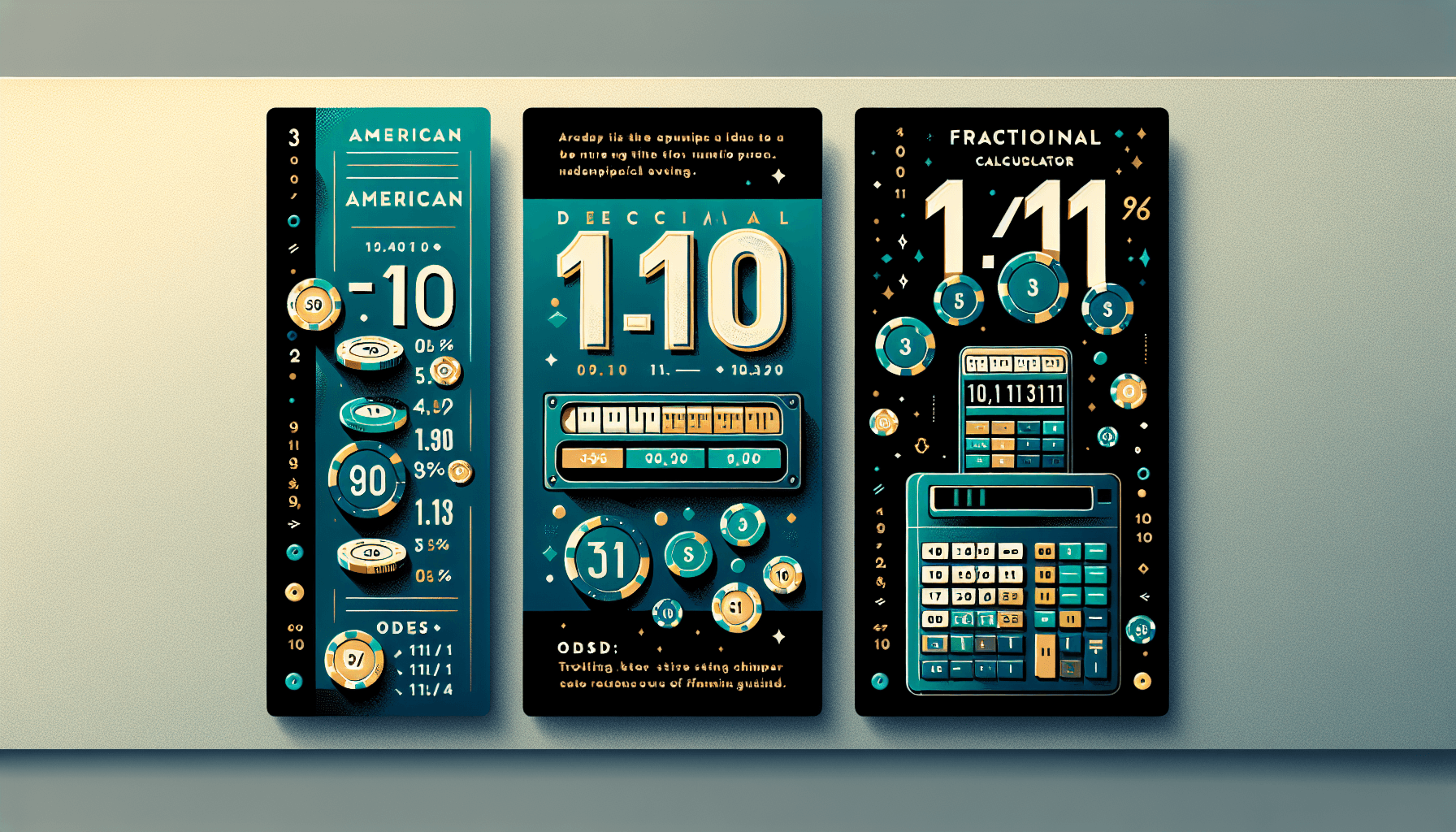
Odds Formats Snapshot
- •American Odds: Used primarily in the US. Expressed as positive (+150) or negative (-200) numbers relative to $100.
- •Decimal Odds: Used in Europe, Australia, and most international sportsbooks. Expressed as a total return multiplier like 2.50.
- •Fractional Odds: Used traditionally in the UK and Ireland. Expressed as a profit ratio like 3/2.
- •Implied Probability: The underlying percentage chance embedded in any odds format. The true universal language of betting.
- •Key Conversion: All three formats express the same information. +150 = 2.50 = 3/2 = 40% implied probability.
- •Why It Matters: International line shopping requires fluency in multiple formats to compare prices instantly.
- •Best Practice: Set your primary display to decimal, but learn to read all three fluently.
If you bet exclusively at one sportsbook in one country, you might never encounter more than one odds format. But the moment you start line shopping across international sportsbooks — and you should, because it is one of the most effective ways to improve your returns — you will encounter American odds at Bovada, decimal odds at Pinnacle, fractional odds at UK bookmakers, and sometimes all three at bet365.
This is not a minor inconvenience. If you cannot fluently read and compare odds across formats, you cannot effectively line shop. You cannot quickly assess value. And you cannot hold a meaningful conversation about odds with bettors from other parts of the world, which matters more than you might think in the era of global betting communities, Discord servers, and cross-border sharp syndicates.
As a quantitative analyst who has worked with odds data professionally for over a decade, I can tell you that fluency in all three formats is the table stakes of serious international betting. This guide teaches you to read, interpret, and convert between all three major odds formats. More importantly, it teaches you how to extract the number that actually matters — implied probability — which is the same regardless of how the odds are displayed. Once you understand implied probability, odds formats become nothing more than different languages expressing the same mathematical concept.
If you are completely new to sports betting, start with our beginner's guide to sports betting for foundational concepts before diving into odds math.
American Odds: The Plus and Minus System
American odds are the standard format at US-facing sportsbooks including Bovada, BetAnything, DraftKings, and FanDuel. They are expressed as positive or negative numbers relative to a $100 baseline.
Negative American Odds (Favorites)
A negative number tells you how much you need to bet to win $100 in profit.
- -110 means you bet $110 to win $100 profit. Total return: $210. This is the standard "juice" line.
- -150 means you bet $150 to win $100 profit. Total return: $250.
- -200 means you bet $200 to win $100 profit. Total return: $300.
- -300 means you bet $300 to win $100 profit. Total return: $400.
- -500 means you bet $500 to win $100 profit. Total return: $600.
The larger the negative number, the heavier the favorite. A team at -500 is a much stronger favorite than a team at -130. Crucially, the relationship is not linear — moving from -110 to -200 represents a much larger shift in probability (52.4% to 66.7%) than moving from -400 to -500 (80.0% to 83.3%). This non-linearity is one of the format's fundamental weaknesses.
Understanding the Non-Linear Scale
This non-linearity trips up many bettors. Let me illustrate:
| American Odds | Implied Probability | Change from Previous Row |
|---|---|---|
| -100 | 50.00% | — |
| -150 | 60.00% | +10.00% |
| -200 | 66.67% | +6.67% |
| -300 | 75.00% | +8.33% |
| -400 | 80.00% | +5.00% |
| -500 | 83.33% | +3.33% |
| -1000 | 90.91% | +7.58% |
Notice how each additional increment in American odds represents a wildly different change in actual probability. This obscures the real mathematical gap between two odds levels and makes quick comparison unreliable.
Positive American Odds (Underdogs)
A positive number tells you how much profit you win on a $100 bet.
- +100 (even money) means you win $100 profit on a $100 bet. Total return: $200.
- +150 means you win $150 profit on a $100 bet. Total return: $250.
- +200 means you win $200 profit on a $100 bet. Total return: $300.
- +300 means you win $300 profit on a $100 bet. Total return: $400.
- +500 means you win $500 profit on a $100 bet. Total return: $600.
- +1000 means you win $1,000 profit on a $100 bet. Total return: $1,100.
The larger the positive number, the bigger the underdog.
Calculating Implied Probability from American Odds
These formulas should become second nature:
For negative odds: Implied probability = |odds| / (|odds| + 100)
- -200 → 200 / (200 + 100) = 200 / 300 = 66.67%
- -150 → 150 / (150 + 100) = 150 / 250 = 60.00%
- -110 → 110 / (110 + 100) = 110 / 210 = 52.38%
For positive odds: Implied probability = 100 / (odds + 100)
- +150 → 100 / (150 + 100) = 100 / 250 = 40.00%
- +200 → 100 / (200 + 100) = 100 / 300 = 33.33%
- +300 → 100 / (300 + 100) = 100 / 400 = 25.00%
Calculating Payout from American Odds
For negative odds: Profit = (100 / |odds|) x stake
- At -200 with a $50 bet: Profit = (100/200) x $50 = $25. Total return: $75.
For positive odds: Profit = (odds / 100) x stake
- At +200 with a $50 bet: Profit = (200/100) x $50 = $100. Total return: $150.
Strengths and Weaknesses of American Odds
Strengths:
- Immediately clear whether a selection is favored (negative) or underdog (positive)
- The $100 baseline makes profit calculations intuitive for American bettors
- Universal in American sports media — ESPN, Fox Sports, The Athletic, and all broadcasts use this format
Weaknesses:
- Most cumbersome format for mental math and quick comparison
- Comparing -180 to -195 requires calculation to assess which is better value
- Parlay calculations are extremely difficult without converting to decimal first
- The non-linear scale obscures actual probability differences
- The discontinuity from -100 to +100 at even money is awkward mathematically
Decimal Odds: The International Standard
Decimal odds are the global default. They are used at Pinnacle, bet365 (in international mode), and virtually every European, Australian, and Asian sportsbook. They represent the total return on a $1 bet, including your stake.
- 1.10 — Heavy favorite. Return: $1.10 per $1 bet. Profit: $0.10.
- 1.50 — Moderate favorite. Return: $1.50 per $1 bet. Profit: $0.50.
- 1.91 — Standard juice line (equivalent to -110). Return: $1.91 per $1 bet. Profit: $0.91.
- 2.00 — Even money. Return: $2.00 per $1 bet. Profit: $1.00.
- 2.50 — Moderate underdog. Return: $2.50 per $1 bet. Profit: $1.50.
- 3.00 — Significant underdog. Return: $3.00 per $1 bet. Profit: $2.00.
- 5.00 — Major underdog. Return: $5.00 per $1 bet. Profit: $4.00.
- 10.00 — Heavy underdog. Return: $10.00 per $1 bet. Profit: $9.00.
The Elegance of Decimal Odds
Decimal odds are mathematically elegant because they make several important calculations trivial. This is why I use decimal odds exclusively in my professional analysis.
Calculating profit: Profit = (decimal odds - 1) x stake
- Odds 2.50, stake $100 → (2.50 - 1) x $100 = $150 profit
Calculating total return: Return = decimal odds x stake
- Odds 2.50, stake $100 → 2.50 x $100 = $250 total return
Calculating implied probability: Implied probability = 1 / decimal odds
- 2.50 → 1/2.50 = 0.40 = 40%
- 1.50 → 1/1.50 = 0.6667 = 66.67%
- 1.91 → 1/1.91 = 0.5236 = 52.36%
Comparing odds: Higher decimal odds are always better for the bettor. If Pinnacle offers 2.52 and Bovada offers 2.45 on the same selection, Pinnacle is the better price. No calculation needed. This instant comparability is why sharp bettors and professional syndicates overwhelmingly prefer decimal format.
Calculating parlay odds: Multiply the decimal odds of each leg. A three-leg parlay at 1.80, 2.10, and 1.65: 1.80 x 2.10 x 1.65 = 6.237. Stake $100 → total return $623.70. Use our parlay calculator for more complex multi-leg calculations.
Calculating margin: Add the inverse of each decimal price.
- Team A at 1.80, Team B at 2.10: (1/1.80) + (1/2.10) = 0.5556 + 0.4762 = 1.0318
- Margin = 0.0318 = 3.18%
The Decimal Scale: Continuous and Intuitive
Unlike American odds, the decimal scale is continuous — no awkward jump between -100 and +100:
| Decimal Odds | Implied Probability | American Equivalent |
|---|---|---|
| 1.10 | 90.91% | -1000 |
| 1.25 | 80.00% | -400 |
| 1.50 | 66.67% | -200 |
| 1.75 | 57.14% | -133 |
| 1.91 | 52.36% | -110 |
| 2.00 | 50.00% | +100 |
| 2.50 | 40.00% | +150 |
| 3.00 | 33.33% | +200 |
| 4.00 | 25.00% | +300 |
| 5.00 | 20.00% | +400 |
| 10.00 | 10.00% | +900 |
| 20.00 | 5.00% | +1900 |
The scale moves smoothly from heavy favorite (1.10) through even money (2.00) to longshot (20.00) without any discontinuity. This is mathematically and cognitively cleaner.
The only "weakness" of decimal odds is unfamiliarity for American bettors. This barrier disappears after a week of use. If you are serious about improving your betting, make the switch today.
Fractional Odds: The Traditional British Format
Fractional odds have been used in British horse racing and football betting for centuries. They express the profit relative to the stake as a fraction.
- 3/1 ("three to one") — Win $3 profit per $1 staked. Total return: $4.
- 2/1 ("two to one") — Win $2 profit per $1 staked. Total return: $3.
- 3/2 ("three to two") — Win $3 profit per $2 staked. Total return: $5 on $2.
- 5/4 ("five to four") — Win $5 profit per $4 staked. Total return: $9 on $4.
- 1/1 ("evens") — Win $1 per $1 staked. Total return: $2. Even money.
- 1/2 ("one to two" or "two to one on") — Win $1 per $2 staked. Heavy favorite.
- 1/4 ("one to four" or "four to one on") — Win $1 per $4 staked. Very heavy favorite.
- 10/1 ("ten to one") — Win $10 per $1 staked. Major longshot.
Calculating Implied Probability from Fractional Odds
Implied probability = denominator / (numerator + denominator)
- 3/1 → 1 / (3 + 1) = 1/4 = 25.00%
- 2/1 → 1 / (2 + 1) = 1/3 = 33.33%
- 3/2 → 2 / (3 + 2) = 2/5 = 40.00%
- 5/4 → 4 / (5 + 4) = 4/9 = 44.44%
- 1/1 → 1 / (1 + 1) = 1/2 = 50.00%
- 1/2 → 2 / (1 + 2) = 2/3 = 66.67%
Calculating Payout from Fractional Odds
Profit = (numerator / denominator) x stake
- At 3/1 with a $50 bet: Profit = (3/1) x $50 = $150. Total return: $200.
- At 5/4 with a $100 bet: Profit = (5/4) x $100 = $125. Total return: $225.
Common Fractional Odds You Will Encounter
| Fractional | Spoken Form | Decimal Equivalent | American Equivalent |
|---|---|---|---|
| 1/10 | "Ten to one on" | 1.10 | -1000 |
| 1/4 | "Four to one on" | 1.25 | -400 |
| 1/2 | "Two to one on" | 1.50 | -200 |
| 4/6 | "Six to four on" | 1.67 | -150 |
| 10/11 | "Ten to eleven" | 1.91 | -110 |
| EVS | "Evens" | 2.00 | +100 |
| 6/4 | "Six to four" | 2.50 | +150 |
| 2/1 | "Two to one" | 3.00 | +200 |
| 3/1 | "Three to one" | 4.00 | +300 |
| 5/1 | "Five to one" | 6.00 | +500 |
| 10/1 | "Ten to one" | 11.00 | +1000 |
| 100/1 | "Hundred to one" | 101.00 | +10000 |
When You Will Encounter Fractional Odds
Fractional odds appear at traditional UK bookmakers (William Hill high-street shops, Ladbrokes retail), in British horse racing, and occasionally at bet365 when the display is set to the UK default. Most online sportsbooks now default to decimal. Many UK-based betting forums, tipster communities, and social media accounts still quote odds in fractional format out of tradition.
The Drawback of Fractional Odds
Fractional odds are the least intuitive format for quick comparison. Is 11/8 better or worse than 6/4? The answer is not immediately obvious. (6/4 is better — it equals 2.50 decimal versus 2.375 for 11/8.) Another challenge: fractional odds do not handle fine-grained pricing well. The difference between 1.91 and 1.95 in decimal is clear and meaningful; in fractional, these become 10/11 and approximately 19/20, which are harder to compare at a glance.
This is why even UK sportsbooks are migrating toward decimal as the default.
Converting Between Formats: Complete Formulas
Being able to convert between formats is essential for line shopping across international sportsbooks. I recommend bookmarking this section until the conversions become second nature.
American to Decimal
-
Positive American: Decimal = (American / 100) + 1
-
+150 → (150/100) + 1 = 2.50
-
+200 → (200/100) + 1 = 3.00
-
+300 → (300/100) + 1 = 4.00
-
Negative American: Decimal = (100 / |American|) + 1
-
-200 → (100/200) + 1 = 1.50
-
-150 → (100/150) + 1 = 1.67
-
-110 → (100/110) + 1 = 1.91
Decimal to American
-
Decimal 2.00 or higher: American = (decimal - 1) x 100
-
2.50 → (2.50 - 1) x 100 = +150
-
3.00 → (3.00 - 1) x 100 = +200
-
Decimal below 2.00: American = -100 / (decimal - 1)
-
1.50 → -100 / (1.50 - 1) = -200
-
1.67 → -100 / (1.67 - 1) = -149 (approximately -150)
-
1.91 → -100 / (1.91 - 1) = -110
Fractional to Decimal
Decimal = (numerator / denominator) + 1
- 3/2 → (3/2) + 1 = 1.5 + 1 = 2.50
- 3/1 → (3/1) + 1 = 3 + 1 = 4.00
- 1/2 → (1/2) + 1 = 0.5 + 1 = 1.50
- 11/8 → (11/8) + 1 = 1.375 + 1 = 2.375
Decimal to Fractional
Fraction = (decimal - 1) expressed as a simplified fraction
- 2.50 → 2.50 - 1 = 1.50 = 3/2
- 3.00 → 3.00 - 1 = 2.00 = 2/1
- 1.50 → 1.50 - 1 = 0.50 = 1/2
- 4.50 → 4.50 - 1 = 3.50 = 7/2
American to Fractional
Convert American to decimal first, then decimal to fractional:
- +150 → 2.50 → 3/2
- -200 → 1.50 → 1/2
- +300 → 4.00 → 3/1
- -150 → 1.667 → 2/3
Fractional to American
Convert fractional to decimal first, then decimal to American:
- 3/1 → 4.00 → +300
- 1/2 → 1.50 → -200
- 5/4 → 2.25 → +125
- 11/8 → 2.375 → +137.5 (typically rounded to +138)
The Quick-Convert Shortcut
For quick mental conversions, memorize these anchor points:
| American | Decimal | Mental Note |
|---|---|---|
| -110 | 1.91 | The standard juice line |
| +100 | 2.00 | Even money — the pivot point |
| -200 | 1.50 | 2:1 favorite |
| +200 | 3.00 | 2:1 underdog |
| -300 | 1.33 | 3:1 favorite |
| +300 | 4.00 | 3:1 underdog |
Once you have these memorized, interpolate. +175 is between +150 (2.50) and +200 (3.00), so approximately 2.75 decimal (and indeed, that is exact).
For precise conversions on any odds, use our odds converter tool.
Comprehensive Conversion Table
This reference table covers the most commonly encountered odds across all three formats. Bookmark this page or use our odds probability converter tool for instant conversions.
| American | Decimal | Fractional | Implied Probability | Common Context |
|---|---|---|---|---|
| -2000 | 1.05 | 1/20 | 95.24% | Extreme chalk |
| -1000 | 1.10 | 1/10 | 90.91% | Massive favorite |
| -500 | 1.20 | 1/5 | 83.33% | Very heavy favorite |
| -400 | 1.25 | 1/4 | 80.00% | Heavy favorite |
| -300 | 1.33 | 1/3 | 75.00% | Strong favorite |
| -250 | 1.40 | 2/5 | 71.43% | Solid favorite |
| -200 | 1.50 | 1/2 | 66.67% | Clear favorite |
| -175 | 1.57 | 4/7 | 63.64% | Moderate-strong favorite |
| -150 | 1.67 | 2/3 | 60.00% | Moderate favorite |
| -130 | 1.77 | 10/13 | 56.52% | Slight favorite |
| -120 | 1.83 | 5/6 | 54.55% | Slight favorite |
| -115 | 1.87 | 20/23 | 53.49% | Near pick-em with juice |
| -110 | 1.91 | 10/11 | 52.38% | Standard juice line |
| -105 | 1.95 | 20/21 | 51.22% | Reduced juice (BetAnything) |
| +100 | 2.00 | 1/1 (EVS) | 50.00% | Even money / pick-em |
| +105 | 2.05 | 21/20 | 48.78% | Near even underdog |
| +110 | 2.10 | 11/10 | 47.62% | Slight underdog |
| +120 | 2.20 | 6/5 | 45.45% | Slight underdog |
| +130 | 2.30 | 13/10 | 43.48% | Mild underdog |
| +150 | 2.50 | 3/2 | 40.00% | Moderate underdog |
| +175 | 2.75 | 7/4 | 36.36% | Notable underdog |
| +200 | 3.00 | 2/1 | 33.33% | Significant underdog |
| +250 | 3.50 | 5/2 | 28.57% | Clear underdog |
| +300 | 4.00 | 3/1 | 25.00% | Major underdog |
| +400 | 5.00 | 4/1 | 20.00% | Heavy underdog |
| +500 | 6.00 | 5/1 | 16.67% | Very heavy underdog |
| +750 | 8.50 | 15/2 | 11.76% | Long shot |
| +1000 | 11.00 | 10/1 | 9.09% | Major long shot |
| +2000 | 21.00 | 20/1 | 4.76% | Extreme long shot |
| +5000 | 51.00 | 50/1 | 1.96% | Near-impossible |
Implied Probability: The Number That Actually Matters
Regardless of whether you see +150, 2.50, or 3/2, the underlying information is identical: the sportsbook believes (or is pricing as though) the selection has approximately a 40% chance of winning. That 40% is the implied probability, and it is the only number that truly matters for betting decisions.
When you evaluate a bet, the question is never "are the odds good?" in the abstract. The question is: "Does this selection win more often than the implied probability suggests?" If you believe a team wins 50% of the time and the implied probability is 40%, you have found a value bet. If you believe a team wins 35% of the time and the implied probability is 40%, you should pass.
The Universal Implied Probability Formulas
| Format | Formula | Example |
|---|---|---|
| American (negative) | IP = |odds| / (|odds| + 100) | -200 → 200/300 = 66.67% |
| American (positive) | IP = 100 / (odds + 100) | +150 → 100/250 = 40.00% |
| Decimal | IP = 1 / decimal odds | 2.50 → 1/2.50 = 40.00% |
| Fractional (a/b) | IP = b / (a + b) | 3/2 → 2/5 = 40.00% |
All four formulas produce the same result for equivalent odds. This confirms that odds formats are merely different presentations of the same underlying probability.
How to Think in Implied Probability
Train yourself to instantly convert to implied probability when you see odds:
- -200 (1.50, 1/2): The book says this outcome happens about 67% of the time. Do you agree?
- +150 (2.50, 3/2): The book says about 40% chance. Is it actually higher?
- +300 (4.00, 3/1): The book says about 25%. Do you see it at 30%+? That is a value bet.
- -110 (1.91, 10/11): The book says about 52.4%. This is the standard juice level — you need to think the true probability exceeds 52.4% for the bet to have value.
Key Implied Probability Benchmarks
| Probability | What It Means | Approximate Odds |
|---|---|---|
| 80%+ | Should win 4 out of 5 times | -400 or shorter |
| 66.7% | Should win 2 out of 3 times | -200 / 1.50 |
| 60% | Should win 3 out of 5 times | -150 / 1.67 |
| 52.4% | Breakeven at -110 juice | -110 / 1.91 |
| 50% | True coin flip | +100 / 2.00 |
| 40% | Wins 2 out of 5 times | +150 / 2.50 |
| 33.3% | Wins 1 out of 3 times | +200 / 3.00 |
| 25% | Wins 1 out of 4 times | +300 / 4.00 |
| 20% | Wins 1 out of 5 times | +400 / 5.00 |
| 10% | Wins 1 out of 10 times | +900 / 10.00 |
Removing the Margin to Find True Probability
The implied probabilities on all outcomes in a market always sum to more than 100% at any real sportsbook. The excess is the bookmaker's margin. To find the true probability the bookmaker believes, remove the margin using the multiplicative method:
Example market: Team A at 1.80 decimal, Team B at 2.10 decimal.
| Outcome | Decimal | Raw Implied | Devigged (True) |
|---|---|---|---|
| Team A | 1.80 | 55.56% | 55.56% / 103.18% = 53.85% |
| Team B | 2.10 | 47.62% | 47.62% / 103.18% = 46.15% |
| Total | 103.18% | 100.00% |
The 3.18% excess is the margin. The devigged numbers represent the bookmaker's actual assessment stripped of the house edge. If your model gives Team A a 58% chance, you have a meaningful edge. For a deep dive into margins, see our complete guide to how betting margins work.
How to Identify Value from Odds
Value is the fundamental concept that separates professional bettors from recreational bettors. A value bet exists when the probability you assign to an outcome is higher than the implied probability of the odds offered.
Step-by-Step Value Assessment
- Convert the odds to implied probability using the formulas above
- Estimate the true probability using your research, models, or expert judgment
- Compare: If your estimated probability > implied probability, there is potential value
- Calculate the edge: Edge = Your Probability - Implied Probability
- Assess confidence: Is your edge larger than the margin? Are you confident in your probability estimate?
Value Assessment Example: Premier League
Premier League match: Arsenal vs. Manchester City
Pinnacle offers Arsenal to win at 3.40 decimal (+240 American, 12/5 fractional).
- Implied probability: 1/3.40 = 29.41%
- Your model estimates Arsenal wins 34% of the time.
- Edge: 34% - 29.41% = 4.59 percentage points
- Expected value per $100 bet: (0.34 x $240) - (0.66 x $100) = $81.60 - $66.00 = +$15.60
This is a clear value bet. Over many similar bets with a 4.5%+ edge, you will profit significantly. But value betting requires discipline — a 34% probability means you lose 66% of the time. The edge only manifests over large sample sizes.
For more on value betting strategy, see our bankroll management guide.
Why This Matters for International Bettors
If you bet across Bovada (American odds), Pinnacle (decimal odds), and a UK bookmaker (fractional odds), you cannot compare prices without converting to a common format. The fastest approach is to convert everything to implied probability:
| Sportsbook | Format | Odds | Implied Probability |
|---|---|---|---|
| Bovada | American | -180 | 64.29% |
| Pinnacle | Decimal | 1.58 | 63.29% |
| UK Book | Fractional | 4/7 | 63.64% |
Pinnacle offers the best price (lowest implied probability = best odds for the bettor). You bet at Pinnacle. This five-second comparison requires fluency in all three formats, which is why we recommend building that fluency now. Use our live odds comparison page to see prices from multiple books simultaneously.
Odds Format by Region: Who Uses What
North America: American Odds
Used at: Bovada, BetAnything, DraftKings, FanDuel, BetMGM, Caesars, all state-regulated US sportsbooks.
Culture: Deep integration with the "$100 baseline" thinking. American bettors talk about "laying 110" or "getting plus-200." All US broadcast networks, podcasts, and media display American odds.
Europe and International: Decimal Odds
Used at: Pinnacle, bet365 (international mode), Betfair Exchange, Unibet, William Hill (online), virtually every European and Asian sportsbook. Also standard in Australia and New Zealand.
Culture: The default for quantitative bettors, professional syndicates, and betting exchange users worldwide. The mathematical simplicity makes it the preferred format for spreadsheet modeling and professional analysis.
Trend: Decimal is winning globally. Even traditionally fractional markets (UK) are shifting to decimal online.
United Kingdom: Fractional Odds (Declining)
Used at: Traditional UK retail bookmaker shops, British horse racing, some UK forums and tipster communities.
Culture: Deeply embedded in British horse racing tradition ("five to two on the favorite"). The traditional format at Cheltenham, Royal Ascot, and the Grand National.
Trend: Declining steadily. Most UK online sportsbooks now default to decimal for new accounts.
Asia: Decimal and Regional Variants
Asian sportsbooks predominantly use decimal odds, though some markets use regional variants. Hong Kong odds show only the profit portion (equivalent to decimal minus 1). Indonesian odds resemble American odds expressed as decimals. Malaysian odds are a hybrid format.
For most international bettors, fluency in American and decimal covers 95%+ of all sportsbooks worldwide.
Regional Default Summary
| Region | Default Format | Secondary Format |
|---|---|---|
| United States | American | Decimal (at exchanges) |
| Canada | American | Decimal |
| United Kingdom | Fractional/Decimal | Both common online |
| Ireland | Fractional | Decimal |
| Continental Europe | Decimal | — |
| Australia | Decimal | — |
| Asia | Decimal/HK/Malay | Varies by market |
| South America | Decimal | American |
| Africa | Decimal | Fractional (SA, Kenya) |
How Our Recommended Sportsbooks Display Odds
Here is what you will see by default at each of our recommended books, and how to change it.
Bovada
- Default: American
- Change it? Yes — toggle in account settings
- Available formats: American, Decimal, Fractional
- Note: Interface designed around American odds. Toggle works but layout feels most natural with American.
BetAnything
- Default: American
- Change it? Yes — format toggle available
- Available formats: American, Decimal
- Note: The -105 reduced juice is displayed identically in all formats. -105 American = 1.952 decimal. The value is the same.
bet365
- Default: Varies by region (UK: fractional; international: decimal)
- Change it? Yes — easily toggled in the top-right corner
- Available formats: American, Decimal, Fractional
- Note: bet365 has the best multi-format support of any sportsbook. Switching is instant. Experiment with all three to build fluency.
Pinnacle
- Default: Decimal
- Change it? Yes — format selector in settings
- Available formats: American, Decimal, Hong Kong, Indonesian, Malay
- Note: Pinnacle caters to professional bettors globally and supports the widest range of formats. Decimal is the natural choice here.
For full comparisons, read our reviews: Bovada | BetAnything | bet365 | Pinnacle
Worked Examples: Real-World Scenarios
Example 1: Comparing NFL Odds Across Books
You want to bet on the Buffalo Bills moneyline.
| Sportsbook | Format | Odds | Implied Probability |
|---|---|---|---|
| Bovada | American | -165 | 62.26% |
| Pinnacle | Decimal | 1.63 | 61.35% |
| bet365 | Fractional | 8/13 | 61.90% |
Converting to implied probability reveals Pinnacle offers the best price (lowest IP = best odds for the bettor). That 0.91 percentage point difference versus Bovada is real money over hundreds of bets.
Example 2: Premier League BTTS Market
BTTS Yes on Liverpool vs Arsenal:
| Sportsbook | Odds | Decimal | Implied Probability |
|---|---|---|---|
| bet365 | -125 | 1.80 | 55.56% |
| Pinnacle | 1.85 | 1.85 | 54.05% |
| Standard Book | -140 | 1.71 | 58.48% |
On a $100 bet, you win $85 at Pinnacle versus $80 at bet365 versus $71 at the standard book. Same bet, different return, purely based on which price you accept.
Example 3: Parlay Calculation in Decimal
Three-leg Premier League parlay:
| Leg | Selection | Decimal Odds |
|---|---|---|
| 1 | Man City -1.0 AH | 1.90 |
| 2 | Arsenal ML | 1.75 |
| 3 | Liverpool Over 2.5 | 1.85 |
Parlay odds: 1.90 x 1.75 x 1.85 = 6.15
On a $50 stake: Total return = $50 x 6.15 = $307.50 (profit of $257.50). Try this with American odds and you need to convert each leg first. Try our parlay calculator for margin analysis on multi-leg bets.
Example 4: Finding Value Through Implied Probability
A bookmaker offers Manchester United at +220 (3.20 decimal, 11/5 fractional) to beat Chelsea.
Implied probability: 100 / (220 + 100) = 100 / 320 = 31.25%
Your analysis, based on xG data, team news, and tactical matchup evaluation, gives Manchester United a 37% chance of winning. The difference between your 37% estimate and the market's 31.25% represents approximately 5.75 percentage points of edge — a significant value opportunity.
Example 5: Cross-Format Line Shopping for NBA
You like the Phoenix Suns +4.5 in an NBA game.
| Sportsbook | Format | Odds | Implied Probability | Potential Profit on $100 |
|---|---|---|---|---|
| Bovada | American | -110 | 52.38% | $90.91 |
| BetAnything | American | -105 | 51.22% | $95.24 |
| Pinnacle | Decimal | 1.98 | 50.51% | $98.00 |
| bet365 | Fractional | 10/11 | 52.38% | $90.91 |
Pinnacle offers the best price at 1.98 decimal. That $7.09 per-bet difference versus Bovada and bet365 is meaningful over a season. At 200 NBA bets, it is $1,418.
Which Format Should You Use?
If you primarily bet at US-facing sportsbooks and do not shop internationally, American odds are fine. They are what you will see at Bovada, BetAnything, DraftKings, and FanDuel.
If you bet internationally, line shop across multiple platforms, or want the most mathematically convenient format, switch to decimal odds. The ease of comparison, the simplicity of the implied probability calculation, and the straightforward parlay math make decimal the objectively superior format for analytical betting.
Fractional odds are a legacy format you should understand but do not need to use as your primary display unless you are deeply embedded in UK horse racing culture.
The Format Hierarchy for Sharp Betting
- Think in: Implied probability (your internal language)
- Display in: Decimal odds (easiest comparison, simplest math)
- Be fluent in: American odds (unavoidable at US books)
- Be literate in: Fractional odds (UK content, horse racing)
My Recommendation
Set your default display to decimal odds. Learn to read American odds fluently because you will encounter them constantly in American media and at US-facing books. Understand fractional odds well enough to convert them. And always think in terms of implied probability, because that is the format your decision-making should operate in.
For practical application of odds knowledge, read our guides on how betting margins work and bankroll management.
The Bottom Line
Odds formats are a language barrier, not a mathematical barrier. Once you understand that +150, 2.50, and 3/2 all represent the same 40% implied probability, the formats become interchangeable tools rather than confusing obstacles. The formulas in this guide will get you fluent within a week of active use.
But the deeper lesson is this: always think in implied probability. It is the universal language that strips away format differences and reveals what actually matters — whether the odds offer value relative to your assessment of the true probability. Master this concept, and you will make better decisions regardless of which format is on your screen.
Start by setting your displays to decimal at Pinnacle and bet365, practice conversions when you see American odds at Bovada and BetAnything, and always calculate implied probability before placing a bet. Use our odds converter until the conversions become second nature.
Sarah Chen is the Betting Strategy Editor at SportsWagerBlog.com. With a background in quantitative analysis and financial mathematics, she specializes in the mathematical foundations of sports betting — odds theory, margin analysis, and probability modeling. She has been analyzing betting markets professionally for over a decade.
Related Reading:
Frequently Asked Questions
What does -110 mean in American odds?
-110 means you must bet $110 to win $100 in profit. This is the standard "juice" or "vig" on point spread and totals bets at most US sportsbooks. If your bet wins, you receive $210 total ($110 stake plus $100 profit). The implied probability is 52.38%, and the margin is approximately 4.76% on a market with -110 on both sides. In decimal: 1.909. In fractional: 10/11. Read our margins guide for why this matters.
How do I convert +200 American to decimal?
Use the formula: Decimal = (American / 100) + 1. So +200 becomes (200/100) + 1 = 3.00 in decimal odds. This means $3.00 back per $1.00 staked, for a profit of $2.00 per dollar. In fractional: 2/1. Implied probability: 33.33%.
Why do some sportsbooks show different odds on the same event?
Different sportsbooks have different margin structures, customer bases, risk management approaches, and tax burdens. A sportsbook that has received heavy action on one side may adjust odds to balance their book. State tax rates also vary — a sportsbook paying 51% tax in New York must charge wider margins than Pinnacle in a low-tax jurisdiction. This is why line shopping is so valuable. See our offshore vs legal comparison.
What is the implied probability of +150 odds?
40.00%, calculated as 100 / (150 + 100) = 100 / 250 = 0.40. In decimal: 2.50. In fractional: 3/2.
Can I change the odds format at my sportsbook?
Yes. Virtually every online sportsbook allows toggling between formats. Pinnacle defaults to decimal. Bovada and BetAnything default to American. bet365 lets you choose with a single click.
Why do professional bettors prefer decimal odds?
Implied probability is a single division (1 / decimal), comparison between prices is instant (higher = better), parlay calculations are simple multiplication, and margin calculations are straightforward. Decimal removes the cognitive overhead of the +/- system. When comparing odds across five sportsbooks simultaneously, that speed advantage is practical and significant.
What are "Hong Kong odds" and how do they differ from decimal?
Hong Kong odds show only the profit portion. HK odds of 1.50 means $1.50 profit per $1 staked (total return of $2.50). In decimal: 2.50. Conversion: Decimal = HK + 1. Used primarily at Asian sportsbooks and for Asian handicap markets.
How do I calculate parlay odds across different formats?
Convert all legs to decimal, then multiply. A three-leg parlay at -110, +150, and -200 American converts to decimal 1.91, 2.50, and 1.50. Parlay decimal odds: 1.91 x 2.50 x 1.50 = 7.1625. Stake $100 for a total return of $716.25 ($616.25 profit). To convert back to American: (7.1625 - 1) x 100 = +616.
Is there a tool that converts odds formats automatically?
Yes. Our odds converter tool instantly converts between American, decimal, and fractional formats and calculates implied probability. For live odds comparison across multiple sportsbooks, visit our odds page.
What odds format should I use for tracking my bets?
Use decimal odds for record-keeping. The math is simpler (total return = decimal x stake), yield calculations are straightforward, and closing line comparison is easier. When tracking 1,000+ bets over a year, the computational simplicity saves significant time and reduces errors.